Showing posts with label Log Cabin Village. Show all posts

Wednesday, May 12, 2010

The history of the past...

Like most museums, Log Cabin Village maintains archival collections consisting of documents, photographs, newspaper clippings, and other ephemera related to our mission (19th century Texas). We also keep archives related to the Village itself, such as records of special events, cabins being moved in, and particularly noteworthy news stories. While we actively collect the information as we see it, we are also fortunate often to inherit the personal "Village archives" held by dedicated staff and volunteer members when they pass.

Recently we received a wonderful file folder filled with 1960s-1970s newspaper clippings related to the Village. These clippings document everything from a school visit to the work of a resident wood carver. What a treasure!

Here are a couple of my favorites:


This clipping, dated February 15, 1974, shows the Shaw Cabin right after it was converted to a working grist mill. We've been grinding corn in it ever since!

Caption: SPINNING WHEEL--A water-powered grist mill will open tomorrow in Log Cabin Village in Forest Park. Opening is set for 1 p.m. Visitors to the city park will be able to watch corn being ground in the mill, after which it will be offered for sale. Old spinning wheels also will be in operation during the day. Admission to the park is 25 cents for adults, 10 cents for children. Sitting by the water wheel is park curator Mrs. Betty Erie.


I don't have a date for the following clipping, but given its reference to the bicentennial "next year" and the jaunty Colonial (rather than frontier pioneer) costuming, it must be sometime during 1975. Who knew that you could gather vegetables, churn butter, and admire a stereoscope all at the same time? Must be the power of the mob caps...

Caption: BICENTENNIAL CELEBRATION--Three members of the Texas Girls Choir, from left, Karen Jerigan, Lisa Beckner, and Daphne Eley, will be seen in the choir's upcoming spring concert at 8 p.m. Saturday in Convention Center Theater. The girls are in the Pickard Cabin at Log Cabin Village in Forest Park. The theme of the concert will be the nation's 200th birthday next year.


Both clippings are from the Star-Telegram...

Thursday, May 8, 2008

Something old is "new" again...

Our beloved pie safe has come home again! When the Seela was converted to a hands-on cabin last fall, our curator knew it was the perfect time to send this beautiful artifact out for conservation. Thanks to donations from generous patrons, we were able to dip into our improvement fund to make this exciting restoration happen!

The pie safe is a fine example of Texas-made furniture. It was hand-built in the 1880s by a man named Alvin Haubold. He made the cabinet for his family’s food storage. The wire screens kept unwanted pests out while allowing the food to ventilate. Wire screening, which made life quite a bit more comfortable and healthier by keeping insects out of homes, was widely available by the 1870s.

The piece is built out of long leaf pine – a very sturdy and valuable wood from very old trees. These pines grew to be more than 100 feet tall and 10 feet wide. Due to logging, most of these majestic trees had disappeared from Texas by the early 20th century. Today, less than five percent of the original Texas long-leaf pine forests remain.
The pie safe is now able to be viewed in the hallway of the Foster Home, the Village point of entry. We hope you'll come see it!

Tuesday, May 6, 2008

What kind of museum visitor are you?

I recently read an interesting article (“Calling All Spiritual Pilgrims: Identity in the Museum Experience” by John Falk [in Museum, Jan-Feb 2008]) that placed museum visitors into five basic identity-related categories. These categories are based on an extensive body of research into visitor motivation and museum expectations.


These categories are as follows:

i) Explorers—curiosity driven, with a generic interest in the content of the museum (for us, this means they have a general interest in 19th century or frontier Texas history)

ii) Facilitators—socially motivated. Their visit is focused on primarily enabling the experience and learning of others in their accompanying social group (these are your teachers, parents, etc.)

iii) Professional/Hobbyists—feel a close tie between the museum content and their professions or hobbies (i.e. interested in building a cabin or a specific craft our museum demonstrates)

iv) Experience Seekers—motivated to visit because they perceive the museum as an important destination (i.e. visit because "if you visit Fort Worth, you HAVE to see Log Cabin Village!)

v) Spiritual Pilgrims—primarily seeking to have a contemplative, spiritual, and/or restorative experience (looking for respite and "escape" from contemporary life...)

Which of these categories do you think YOU fall under? Does your motivation change according to the needs of those around you?

The whole concept of visitor motivation is interesting because it reminds us, as a museum, that not all people visit us for the same reason. Therefore we need to ensure that we're meeting the needs of ALL our visitors regardless of their reason for visiting.

So how are we doing? What are your thoughts? How can we improve our service to you?

Monday, April 28, 2008

Reminders...we need you!

Have you noticed the cool links on the right side of the page? We hope you have...and we hope you'll use them!

If you have visited us recently, please take a moment to complete one of our surveys (either the "Group tour" or "General Visitor"). Your comments help us improve the visitor experience for ALL our patrons.

Also...remember that you can help us out just by shopping! Put that economic stimulus check to good use...and raise money for Log Cabin Village to boot!

Friday, April 25, 2008

Pioneer Times Innovation Awards Grand Prize Winner!

Log Cabin Village and the Log Cabin Heritage Foundation would like to congratulate grand prize winner Angel Escobar!

Every 4th grade class who visits Log Cabin Village is eligible to enter the Pioneer Times Innovation Awards contest. Entrants are instructed to select from one of the following prompts:

· Students may design their own dream log cabin. This cabin can be as creative and contain as many amenities (historical, not modern—No GameCubes or Satellite dishes!) as the student desires. As the students imagine their dream cabin, have them consider what might make their lives easier or be useful in their small home based on their experience at Log Cabin Village.

· Based on what they learned about frontier living during their visit to Log Cabin Village, students may create an invention that would have made life easier in the 19th century. This invention does not need to be completely grounded in reality; the more fanciful the better (i.e. an automatic chalk-picker-upper for the school)! While it is okay for students’ inventions to be something that actually exists, the design MAY NOT exactly duplicate modern devices (i.e. drawing a Maytag washing machine). The design needs to be original!


Angel's innovative "heated floor" design won him $1100 in savings bonds and the respect of all his peers. His entry beat out over 400 other extremely qualified candidates! Great job, Angel!


Ms. Linda Taylor, Angel's homeroom teacher at Chisholm Ridge Elementary, Angel, and Log Cabin Village Director, Kelli Pickard


Angel's prize-winning entry:


"My invention would be a heated floor. You could fill holes that were underground with hot coal or wood. You put the coal under a space in the floor. The floor would be made of slate. Slate is a rock that holds heat. The coal or wood could warm the log cabin floors in the winter. Then in the summer you could put cool water from the river in the hole to cool the slate floors down. That is my 1800s invention. I hope that if the 1800s pioneers were here that they would use it."

Thursday, April 24, 2008

"It Belongs in a Museum!" How to donate artifacts to Log Cabin Village

Do you have an heirloom that you feel should be in a museum? Would you like to see an object that you presently own preserved for posterity? If you do, you may consider donating them to Log Cabin Village. From furniture to textiles to tools, the museum is home to many everyday artifacts that provide us with a fascinating glimpse at nineteenth century Texas life.

The museum also has an archival collection of letters, photographs, and other nineteenth century documents. So how did the museum acquire all these wonderful collections? Mostly, through individual donations from individuals and families!


If you do have an object that you would like to donate, first ask yourself these questions:


  • Is the object from within the time period the Village interprets (1840 through 1890). Objects dating earlier than 1840 may be appropriate if they were still in use during this time period.

  • Is the object relevant to Texas history?

  • Does the object have a recorded history or provenance? In other words, can you determine who used it, for how long and for what?

  • Is the object in good condition?

If you answered yes to all these questions, your object may be a good candidate for donation to the museum! If you would like to discuss the possibility, contact us. The museum will then determine acceptance based on the factors above as well as whether the museum has any foreseeable use for the object, if the museum has excessive objects similar to that one, and whether the museum can properly care for the object. Who knows, that wedding dress that your great-great grandma wore can indeed become a museum piece!

Wednesday, April 23, 2008

Just like the old days...

A power outage at the Village today afforded us the rare opportunity to show folks what it was really like "back then." The cabins looked much different dimly illuminated by natural light. Our school groups LOVED the experience--they didn't want to leave.

Life without electric light, while annoying at times, is also strangely peaceful.

Here are a couple of videos illustrating the importance of windows and natural light to those living without electricity. Pardon the quality of the video...it's a little rocky (hence the reason I'm an educator, not a filmaker :) )...

The first video is from our Marine School...a place with a lot of windows...

The second is from the Seela hands-on cabin. No window...but a lot of darkness.

Enjoy!


Power outage at Log Cabin Village, Fort Worth, TX--Marine School from logcabinvillage on Vimeo.


Power outage at Log Cabin Village, Fort Worth, TX--Seela hands-on cabin from logcabinvillage on Vimeo.

Tuesday, April 22, 2008

Sleep tight?

Even though the whole "sleep tight, don't let the bedbugs bite" saying more than likely doesn't originate with the rope bed, being comfortable certainly did mean that you needed to tighten the ropes now and again.

We have a rope bed here in our hands-on cabin...and today was rope-tightening time! So if you've never understood how a rope bed works...watch and learn...


Tightening the Rope Bed at Log Cabin Village, Fort Worth, TX from logcabinvillage on Vimeo.

Wednesday, April 16, 2008

Thyme for healing...

Note: the information provided here is for educational purposes only. Before using any plants and their derivatives, you should seek the advice and training of a qualified professional and your personal physician.

Okay...now that the disclaimer is out of the way...let's talk herbs. We have a wonderful herb garden here at the Village, and an even MORE WONDERFUL group of people who manage it: The Greater Fort Worth Herb Society. Why herbs at a frontier Texas living history museum, you ask? Herbs played very important roles in the lives of our ancestors. Early Texans used them for cooking, cleaning, and healing. Although we are still unraveling the mystery of "natural" healing, we can acknowledge that the pioneers were definitely on to something.


We love the annual "Thyme for a Cure" event for a few reasons. It gives us a chance to collaborate with our Herb Society volunteers and highlight their hard work. It allows us to illustrate different aspects of health and medicine. And finally (and perhaps most importantly), it gives us the opportunity to make all sorts of goofy puns using the word "thyme" (this is second only to the pun chances with "corn" and "Maize Days" in the fall).


Just for fun, here's a list of herbs and other plants early Texans may have used (and why) in everyday life:


Lamb’s Ear (aka "woundwort") – may have been used as a bandage

Lemon Balm – This herb was used to make tea, and the leaves were put in bath water. Pioneers also chewed the leaves to help get rid of a headache. Insomnia, bacterial infections, cold sores, calms nerves

Feverfew—fever—Native Americans used it for burns

Artemisia (Wormwood) —“mountain” fever

Lemon Verbena—well-being/love (aromatherapy), tea, lemonade

Lemon Balm--sedative, inhibit growth of fungi and bacteria

Rosemary – Pioneers burned the plant to make the air smell nice, and to keep the bugs away, nervousness

Mint – This herb was used in cooking, and to make tea. Pioneers also chewed on the leaves to cure bad breath. They also thought it could cure hiccups, upset stomach.

Oregano – Pioneers used this herb in their bath, to make tea, and they made it into a lotion that they used for pain and swelling.

Sage—cough and cold, upset stomach

Cat Mint – Today called “Catnip,” the dry leaves of this herb were burned to put a calming scent in the air, fever, babies with colic or colds

Lavender – Pioneers would rub the leaves on their body to keep the bugs away. They also used it to make tea to soothe headaches and make their breath smell nice.

Marjoram—asthma

Basil—nausea

Parsley—upset stomach, diuretic, vitamin C

Tansy—vegetable dye, leaves collected for food

Thyme--deodorant, local anesthetic, antiseptic

Skullcap—relaxation, exhaustion

Trumpet vine--Brought from the East Coast and grown for home beautification

Hollyhock--Cultivated for home beautification

Clove Currant--Fruit and leaves collected for food

Soapwort--Leaves and stems collected for making soap

Wild Onion--Leaves and bulbs collected for food

Prairie Sage--Leaves collected for making tea

Mexican Plum--Fruit collected for food

Crested Iris--Collected and grown for ornamental value

Wild Ginger--Roots collected and used for seasoning

Passion Vine--Fruit collected for food

Harison’s Yellow Rose--Brought from the East Coast and grown for home beautification

Butterfly Weed--Roots collected for food

Sassafras--Roots and bark collected for making tea

Beebalm--Leaves collected and used for seasoning

Wild Garlic--Roots collected and used for seasoning

Redbud--Native tree grown for home beautification

Blackberry--Fruit collected for food

Wild Plum--Fruit collected for food

Yucca--Roots collected and used for making soap

Sunflower--Seeds collected for food

Horseradish--Roots collected for food

Links to more information...

Thursday, April 10, 2008

Storm Damage...

As storms rumbled through North Texas early this morning, many folks in our area found themselves without power and greeted by large limbs scattered everywhere.

Here at Log Cabin Village, we were pretty lucky. We do have some limbs down (and Bobo Woods across the street has A LOT of limbs down), but we still have power and none of the cabins were damaged.

We hope all our friends and neighbors are okay as well!

Here's a slideshow with some photos taken this morning...

Monday, April 7, 2008

Pioneers were "green" before "green" was cool!

Since we celebrate both Earth Day and Arbor Day this month, I decided that it might be nice to recognize our ancestors and their "green" ways! They were earth-friendly out of necessity, but you can follow some of their ways of life, learn a little, and make a big positive impact on the earth!

Here are a few ways that 19th century Texans were "Green:"

1. Because of distance from supply lines, our ancestors were often quite self-sufficient. They used local merchandise, grew their own vegetables and grains, and ate what was "in season." Eating "in season" and buying local can benefit us now, also! Your produce travels an average of 1500 miles before it gets to your table. This means that vitamins and taste are sacrificed, and lots of fuel is burned in the process.

What you can do: Try to buy local whenever possible. Support your friends and neighbors. Or grow your own fruits and vegetables! Go organic if you can... Check out gotexan.org or your local extension office for more local information...

2. Our ancestors were recyclers! Leftover dish water was used to irrigate the garden. Clothes were handed down, stitched up, patched, and eventually shredded into rags to use for quilts, rugs and other necessary items. Beef tallow was made into candles. You get the picture!

What you can do: Participate in your local recycling program. Donate your gently used toys and clothes to local charities. Reduce your overall "consumption" so that there's less to recycle!

3. Waste not, want not was a way of life for our ancestors. Our Native American ancestors used every part of the bison when they killed it. Non-edible parts of vegetables were composted into mulch to naturally fertilize gardens. Tools, implements, and furniture were repaired rather than repurchased when they broke. Parts of the corn plant were used for everything from back scratchers (corn cobs) to mattress stuffing (corn husks)!

What you can do: Do some composting of your own! Buy only the food you need and be sure to eat/freeze all of it (and eat your leftovers). Repair things around your house rather than discarding broken items to purchase new. Get creative with ways to repurpose common things! Make "throwing away" your last and final option...

4. Our ancestors didn't use disposable cups, plates, utensils, sippies, paper, bags, etc. They used slates for school (paper was too expensive to be "wasted"). They washed and reused their tableware. They used fabric tablecloths.

What you can do: Just say "NO" to disposable unless absolutely necessary. Use your paper sparingly, and use the back side of discarded paper as "scratch" paper. Carry your own water bottle rather than drinking from plastic. Take your own bags to the grocery store. If you really need to use disposable tableware, try eco-friendly options like these or these.

5. Early to bed...early to rise. Yep...our ancestors followed the sun when they set their workday. Candles and lamp oil were in limited supply, so in general, 19th century families were up with the sun, and in bed when the sun went down. They took advantage of natural light so that they could make the most of their limited resources.

What you can do: Take advantage of natural light as much as possible. Turn lights off when you leave a room. Replace your incandescent light bulbs with compact fluorescents when possible. Unplug appliances that are not in use to prevent the "phantom load" phenomenon.

6. Our ancestors didn't have "digital waste." Period. What I mean by "digital waste" is that they didn't have computer monitors, televisions, stereos, mp3 players, and other electronic items with potentially dangerous components that they needed to dispose of.

What you can do: If there's anything we currently excel at, it's coming up with tons of "digital waste." So how can we safely dispose of it? First, if your item still works or only needs minor repair, you might try freecycling it. Perhaps someone else can bring it to life! You can also check with your local Environmental Management agency. In Fort Worth, you can contact them here. Many computer companies will take your old computers back, so investigate those options before you buy new, and support those companies with recycling programs! Encourage television manufacturers to help further recycling efforts as well!

7. Our ancestors built their homes with nature in mind. They took advantage of natural shade, they situated their homes so that breezes would run through "dogtrots," and they used natural light. They also used local, earth-friendly materials.

What you can do: If you are building a home, keep nature in mind. Contact local agencies to help you determine how your home can be more "green." In Texas, find out more information here.

These are just a few ideas. From your experiences with Log Cabin Village and life on the Texas frontier, what else can you think of? Leave us some comments with your thoughts...

Thursday, April 3, 2008

Thirteen things to look for when you visit...

It's time for another "Thursday 13!" May we present...Thirteen things to look for when you visit Log Cabin Village!

Handcrank blower


Map of the United States and Mexico in 1847

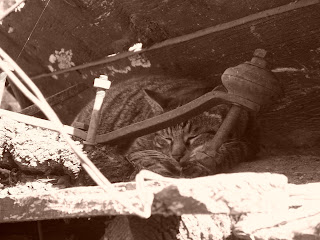
Charlie the cat

Dry sink

Two-faced doll

Wagon Wheel

Candle lantern

Metate y mano (mortar and pestle)

Wagon

Firepit for cooking

Monday, March 31, 2008

More upgrades!!!

Things just keep looking up at LCV! We have a new candleshed...which means that our fearless candle dippers can be even MORE fearless when rains and falling leaves approach. Sure...our ancestors probably didn't have a shelter devoted ENTIRELY to dipping candles...but then again, our ancestors probably didn't dip candles year round (which we do...unless the weather's too hot for the wax to stick!)

Pretty, isn't it? A big "thank you" to the City of Fort Worth's Transportation and Public Works Department for providing us such an incredibly beautiful and functional piece of architectural art.

You asked. We listened. We now have six new benches upon which you can rest your weary feet while here at the Village. Although they look very wood-like...they are actually made of a durable plastic material which should last a very long time (and hey...no splinters in uncomfortable places!)

We know that many of you have requested real working restrooms instead of portalets also. Good news! We've got new benches! Oh yeah...no real restrooms anytime soon...but we are definitely still listening! :)


And the final improvement we can take absolutely NO credit for. Within the past week, the Village has been enveloped in her beautiful spring dress. The leaves and greenery have once again emerged making LCV an even MORE memorable escape from the present. From snow in early March to paradise in early April... What a difference a month makes!!!

Thursday, March 20, 2008

Miracle Birth at Log Cabin Village!

Every once in a while something happens that just makes you say hmmmmmm...

Spring Break here is always magical...but this year marks an exceptionally exciting chapter in Log Cabin Village's life! We have witnessed a miracle birth. The sweet fluffy yellow chick was born today at Log Cabin Village...but her arrival remains a mystery since our adult chickens and rooster are, in fact, stuffed animals (and quite incapable of spontaneously reproducing).

She was discovered in the chicken coop with the others when LCV interpreter Dave was bringing the hens in for the night. Divine intervention? A chick separated from her true owner? Or perhaps an anonymous gift from a secret admirer?

Only the shadow knows...

Friday, March 14, 2008

Sights that make your heart smile...

You know...most people can't help but smile when they see certain things...those silly e-mail forwards with photos of cats perched in precarious positions, babies giggling, and kids being--well--kids.

Working at Log Cabin Village, we are surrounded with sights that make your heart smile on a regular basis. Today we had Timber Tales preschool storytime, and seeing 30 or so 3-5 year olds in vests, bonnets, and aprons is a priceless thing indeed...especially when they are frantically performing "Heads, Shoulders, Knees, and Toes" with me. I love the little ones...and I love how much they enjoy being out here at the Village and hearing the stories.

Here are some Village sights that will make your heart smile also:

Bugles the cat, hard at work in the wagon...


An intrepid homeschool group (today's storytime participants) experiencing the blacksmith shop


Two former Village volunteers, Khanay and Reagann

A helping hand...

Sweet Iris...enough said.

Taffy the cat in a teeny tiny basket

Checking out the smokehouse...

Fred being a kid again playing with the buzzsaw...

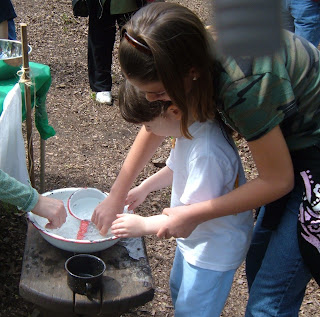
Washing clothes during "Wagons West..."

Are you smiling yet?

Wednesday, March 12, 2008

"Wood"n't you know it?

As a follow-up to our blacksmith interview, today I spoke with Steven Suarez--the Village "jack of all trades"--about woodworking on the frontier. Here's what Steven had to say:

R: What are some of the wooden things that were probably made by hand in frontier Texas?

S: When people traveled to Texas by covered wagon, they had very little room for their possessions--particularly bulky furniture. They would commonly have to make their furniture once they got here to Texas (or whatever other place they were traveling). Families needed beds, chairs, and tables, so furniture-making was quite important. Other useful things were also made by hand, like tool and farm implement handles. If you broke your ax handle while you were out working, you would need to know how to replace it!

R: Why would a woodworker use a shaving horse?

S: The shaving horse was a quick and easy way to clamp wood that you were interested in making round stock (round wood) from. Round stock would be used for tool and gardening handles. You could also use the shaving horse for tapering shakes (shingles) for roofs. The shaving horse's method of clamping (by using your foot rather than having to screw a clamp down) allowed the woodworker to turn and move the wood freely and quickly as it was being shaped. This saved time AND energy.

R: What's your favorite frontier tool to use? Why?

S: I think it would have to be the spokeshave. The spokeshave offers a way to free hand a lot of different shapes in the wood. I've used it to make a hammer and ax handles, legs for a three-legged stool, and other "rounded" projects. It's good for rounding over wood with precision.

R: Which of your woodworking projects are you most proud of?

S: The reconstruction of the Reynold's smokehouse. I hand-hewed two of the replacement logs myself. I enjoyed the challenge of putting it all back together with the proper log placement--it was like working a jigsaw puzzle. You had to look to the wood for clues as to how it all fit together. I draw great satisfaction and enjoyment out of working with wood and creating things with my hands. I feel that God blessed me with the talent, and I'm very grateful to be able to use it here.


Thanks so much, Steven! Come see Steven in action this Saturday!

Tuesday, March 11, 2008

Blacksmith Q & A...


Today I’m visiting with Village blacksmith and store clerk Michael Garrett. Michael is going to share a little information about blacksmithing in anticipation of our upcoming event on Saturday.

R: Michael, why would a frontier Texas community have wanted a blacksmith around?

M: The isolation of the frontier, with its scarcity of available tools and hardware, made a blacksmith invaluable. The Texas frontier was removed from the industrialized centers in the eastern part of the United States, so people there were more reliant upon handmade and hand-forged goods. It wasn’t until later in the 19th century, when the railroad made its way through the frontier, that the role of the blacksmith changed. As goods became mass produced and more widely available, it became cheaper to replace an object than repair it. Blacksmiths remained important, however. They just adapted their roles to serve the existing need.

R: What kinds of things did the blacksmith make?

M: It would be difficult to narrow down to a short list! They made wagon parts, farm tools, and even did some farrier and gunsmithing work. If it was made of metal and it was needed, then more than likely a blacksmith made it.

R: What misconceptions do people have about 19th century blacksmiths?

M: Well, people tend to think that they only made horseshoes. Kids typically think that they made swords. I think these perceptions come from the movies. In reality, blacksmiths made all of the items I mentioned before and more. Also people usually think that nail-making was the blacksmith’s most important job. By the time of the Texas frontier, most people could buy manufactured nails fairly easily. You could get these “cut nails” by the barrel. In addition, making a nail is a fairly straightforward task that could be learned by a novice in basically one day. Most people wouldn’t rely on a blacksmith’s expertise for such a simple job.

R: So the old story about burning down the house to save the nails isn’t true?

M: It’s more than likely true, but probably not of our time period. It would more than likely apply to the Colonial American time period (18th century), before manufactured nails were available. At that time, most nails were hand-wrought and therefore QUITE valuable.

R: What made you first interested in blacksmithing?

M: I’ve always been interested in technology and mechanical things. I decided it would be a fun hobby. I’ve been blacksmithing for 15 or 16 years now, although I’ve only been here at the Village for a little more than 5 years.

R: Well we’re glad you’re here! Thanks for chatting with me today, Michael!

Be sure to come see Michael in action this Saturday!

For more information on blacksmithing, please visit the North Texas Blacksmiths Association or The Artist Blacksmith’s Association of North America.

Monday, March 10, 2008

Kudos? Comments? Concerns?

We now have our evaluations online! Check them out in the blog's left-hand column entitled "Tell us what you think."

If you've visited us recently, please let us know "the score." If you came on a group tour, please click "Group Tour Evaluation." If you were a walk-in general visitor, please click "General Visitor Survey."

We want to hear from YOU!

Friday, March 7, 2008

Scenes from the Village on a Wintry morning...

I've always theorized that Log Cabin Village is so scenic, you can point your camera any direction, "click," and come out with a beautiful photograph. The images are made even more breathtaking when snow dots the landscape.
For your viewing pleasure--