Showing posts with label TCC blog series. Show all posts
Showing posts with label TCC blog series. Show all posts
Tuesday, February 18, 2014
Unionist Texas
Here's our final entry in this year's TCC guest blogger series. Today's entry by Joshua Russell discusses the Civil War and opposing viewpoints in Texas...


Wednesday, February 5, 2014
School Journal
A fictitious frontier school teacher shares an excerpt from her journal in this creative entry from TCC guest blogger Hannah Stewart...
Tuesday, January 28, 2014
Wednesday, January 22, 2014
Schools and Education on the American Frontier
Happy Wednesday! Please enjoy this entry on 19th c. education from TCC guest blogger Brandon Claridge...
Tuesday, January 14, 2014
Religion in frontier Texas
Today's TCC blog series entry comes from Karla Camacho. Very interesting!
Tuesday, December 17, 2013
Expanding Homes
Greetings! Today's entry in our TCC Blog series is by Diana Medrano and D.M. Ruiz. Enjoy!
Tuesday, December 10, 2013
Nineteenth Century Cooking...
Here's our next installment in the TCC blog series, an article about 19th c. cooking by Molly Arkel. Bon appetit!
Tuesday, December 3, 2013
Aunt Molly and Uncle Jeff
Faithful blog followers may remember that we've had an ongoing service-learning partnership with Tarrant County College--Trinity River Campus for a few years now. Every year, dedicated students come tour the Village, help us preserve the cabins by raking leaves, and research and write blog entries for us. This year's entries also include creative fiction writing inspired by Village content.
We will publish these entries here for you to enjoy over the next few weeks. Thank you so much, Professor Blank and students!!!!
Today's entry is from Jazmyn Garcia. In this fictional account, she imagines what a child in the Foster household might have felt upon learning that their freed slaves were staying with the family. Enjoy!
We will publish these entries here for you to enjoy over the next few weeks. Thank you so much, Professor Blank and students!!!!
Today's entry is from Jazmyn Garcia. In this fictional account, she imagines what a child in the Foster household might have felt upon learning that their freed slaves were staying with the family. Enjoy!
Tuesday, May 8, 2012
Cooking Then and Now...
More from our TCC friends...
Lilia Rodriguez
Professor Blank
History 1301
20 April 2012
Hungry?
No time to sit down and have dinner or lunch? Not a problem at all, because you
can drive to any fast food place and your hunger problems will be solved in a
matter of minutes. With so many fast food places now a days as an option to
have a quick meal we have lost appreciation for the work put into preparing our food.
Not so
long ago preparing a meal was not as easy as going to a super market and buying
the ingredients ready just to be cooked. According to Courtney Hybarger author
of When Dinner wasn’t Quick and Easy
“fruits and vegetables were grown on the farmstead and families processed
meats, such as poultry, beef and pork”. In the 1800s families did not have the option
of simply going to the store and buying what they needed. Everything had to be
grown at home for example “spices (nutmeg, cinnamon), seasonings (salt and pepper) had to be ground up with mortars and
pestles (Hybarger)”. These families actually had to make their foods out of
scratch and sometimes this process was an all day thing. They did not have the
convenience of being able to go to a store and buying food that just needed to
be popped in the microwave or cooked on the stove. In the 1800s there was a
huge difference in technology as well.
Refrigerators
an electronic appliance that we consider a necessity to keep our foods from
spoiling was non existent in the 1800s. In the 1800s to keep meats from
spoiling women used a process of curing. In this process meat was dipped in
“brine or salt and then exposed to sun and wind” (Bogan). Fruits and vegetables
on the other hand were placed out in the sun or near a heat source (Hybarger).
It is interesting to say that with very limited resources people managed to be
creative to surpass such obstacles as to how to preserve their foods. Another creative
tool was how they cooked their food.
We
might have microwaves and stoves but in the 1800s none of that existed. Without
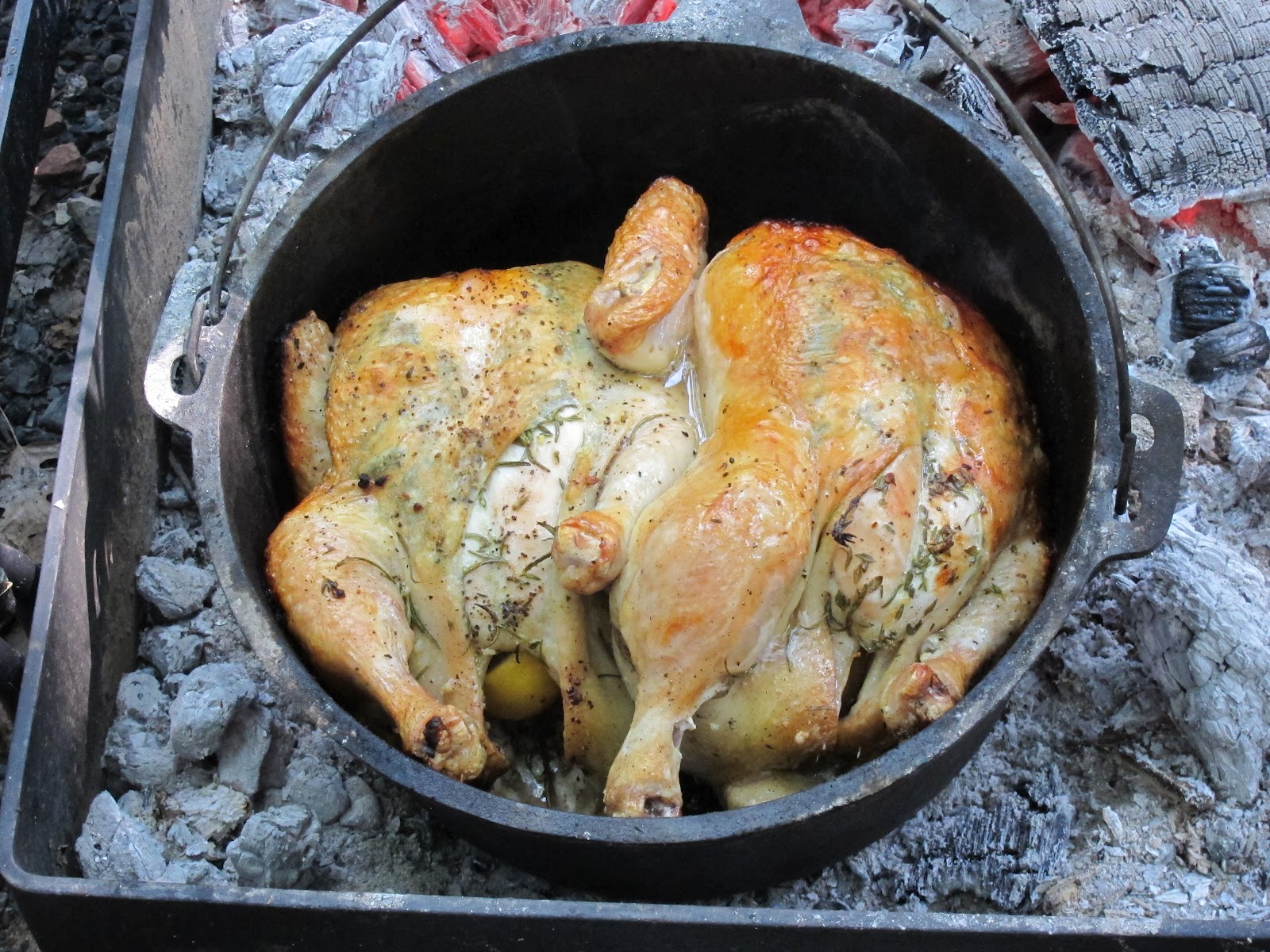
stoves in the 1800s, women used what was a Dutch Oven (Hybarger). They placed
this oven in the hearths of brick fireplaces where they used different types of
fires and flames to cook their meals (Hybarger). For example in todays time you
might be used to running down to a Churches Chicken or KFC if you have a
craving for some chicken but in 1800s as Fannie Farmers states in her book The Boston Cooking-School Cook Book
cooking a Roast Chicken required a long process. For the chicken you first had
to dress, clean, stuff and truss it, then you had to season it and while it is
cooking you had to be checking and turning it so it will not burn (Farmers
251). This process might sound pretty easy and something that many do at a
Thanksgiving meal but imagine not having a stove with an oven and having to
cook it over a fire.
While
in the 1800s cooking was an all day chore because they had to make everything
from scratch and they had to make the perfect fire, today all of that has
dramatically changed. Now in the 21st century we can count on
refrigerators to preserve our foods and we have stoves and microwaves that are
life savers. Besides that we now even have a number of restaurants and fast
food places that provide us with a quick meal without all of the hard work that
was needed in the 1800s.
Works Cited
Cracker Women Cooking Outside their Poor, Rural Cabin in
Georgia. 1800. Painting. Web. 20 Apr 2012.
Farmers, Fannie. The Boston
cooking-School Cook Book. Little Brown: 1918. 251. Print.
(Farmers
251)
Hybarger, Courtney.
"Cooking in the 1800s." When Dinner Wasn’t Quick and Easy.
Web. 20 Apr. 2012
Tuesday, May 1, 2012
Lessons from the Native Americans
Faithful blog followers may remember that we've had an ongoing service-learning partnership with Tarrant County College--Trinity River Campus for a few years now. Every year, dedicated students come tour the Village, help us preserve the cabins by raking leaves, and research and write blog entries for us.
We will publish these entries here for you to enjoy over the next few weeks. Thank you so much, Professor Blank and students!!!!

Andrea
Winburn
History
1301
Lisa Blank
Lessons from the
Native Americans
Life as a pioneer, most definitely contained
struggle and hardship. Plenty of new
experiences took place in these pioneers lives. They were traveling through
landscapes that were foreign to them and encountered Native Americans, who were
also foreign to them. Pioneers included
people from all walks of life, including women. Pioneer women have been
described to be, “weary,
overworked…taken from her happy home, and thrust onto the frontier with all of
its threats and dangers”(Williams). They have also been romanticized as a “strong, brave, moral woman
who headed West as a sort of civilizer and Christianizer of the frontier”(Williams).
Many women had to endure encounters with Native
Americans and were pressed with the duty of protecting their families and
defending their belongings. One account
of a conflict with Native Americans comes from Mrs. Samuel A. Maverick, “Two Indians rushed by me on Commerce Street
and another reached my door, and turned to push it just as I slammed it to and
beat down the heavy bar…One had stopped near Jinny Anderson, our cook, who
stood bravely in front of the children, mine and hers. She held a great stone
in her hands, lifting it above her head, and I heard her cry out to the
Indians: 'G'way from heah, or I'll mash
your head with this rock!'”(Looscan).
There was also quite a bit of fear amongst women as they encountered
Indians for the first time along the trail westward. “They were the first
Indians I had ever seen, and to my frightened vision, dressed in their long
mackinaw blankets with eagle feathers in their hair — my thought was that they
would kill us all, and take my baby in captivity” (Williams). One woman,
Catherine Haun, described her group as performing drills in order to prepare
for a possible Indian raid upon their camp.
However,
after repeated encounters with groups of Indians, the pioneers soon learned
that most Indians actually posed no threat to them. As the two groups became
accustomed to each other, they were able to interact in different ways, like
trading food and learning how to craft different items. Indians that were
encountered along the trail, also acted as guides for the pioneers. The
emigrant women took note of the differences between their culture and that of
the Indians. They noted the dress and
the jewelry of the Indians. “A piece of scarlet broadcloth edged with several
rows of white beads decorates the top of the moccasin and from either side of
this extends around the top of the quarters a little drop curtain effect
fringed by making fine cuts an inch deep around the edges”(Williams).
Overall,
pioneer women’s ideas and opinions about the Indian peoples changed. They were
first seen as worrisome and fear invoking, but soon many women learned that
some of the Indians they encountered were civil people and learned a great deal
from them.
Works Cited
Looscan, Adele.
"Texian Women by Adele Briscoe Looscan." Texas A&M University.
Sons of Dewitt Colony Texas, 1997. Web. 19 Mar. 2012.
Williams, Carol. "My First Indian: Interaction Between Women And
Indians On The Trail, 1845-1865." Overland Journal 4.3 (1986):
13-18. America: History and Life with Full Text. Web. 19 Mar. 2012.
Thursday, March 10, 2011
Tuesday, February 22, 2011
Texas Takes Flight...
Another blog entry from one of our TCC students. This time, Charles Ya tackles Jacob Brodbeck and early flight...
Texas Takes Flight
Texas Takes Flight
Wednesday, February 16, 2011
Glad to Gasp the Gas...
We've written before about our ongoing partnership with Tarrant County College--Trinity River Campus. Over the upcoming months, we will be featuring blog entries and reflective essays written by some of the students who participated this past fall. These entries will be left exactly as the students wrote them.
Today's blog entry comes from Anya Conway. In it, she describes medical advances made in the 19th c., particularly in the area of anesthesia.
Glad to Gasp the Gas
Today's blog entry comes from Anya Conway. In it, she describes medical advances made in the 19th c., particularly in the area of anesthesia.
Glad to Gasp the Gas
Subscribe to:
Posts (Atom)